The 1,999grt Type 1D standard cargo ship Shotan Maru was sunk in Truk Lagoon on the second day of U.S. Task Force 58’s surprise 2-day fast carrier raid, Operation HAILSTONE, by Douglas Dauntless dive bombers from the carrier USS Enterprise. New wreck video tour just posted.
The large 392.5-feet long IJN auxiliary transport vessel Seiko Maru was launched on 14 May 1940 as Japan readied itself for war in the Pacific. She had her machinery, engine and boiler rooms at the stern – so she resembled a tanker or oiler. On 17 February 1944, as Task Force 58 fast carriers launched their surprise 2-day raid codenamed Operation HAILSTONE, she was at anchor in the IJN Fourth Fleet anchorage north east of the man-made aircraft carrier shaped Eten Island. A valuable target she was quickly attacked and took bomb hits aft from USS Enterprise Douglas Dauntless dive-bombers that blew out both sides of her hull. She was set ablaze and settled by the stern into 52 metres of water, where she now sits upright and largely intact – barring the bomb damage aft.
Just posted another dive video on my YouTube channel, this time of the large Japanese WWII shipwreck in Truk Lagoon, Kiyosumi Maru. This ship started out life in 1934 as a passenger cargo liner but was requisitioned into the Imperial Japanese Navy (IJN) in 1941 in the run up to the Pacific War.
She served initially as an armed merchant cruiser before being reassigned as an auxiliary transport. She was undergoing repairs in Truk Lagoon from convoy bomb damage when the fast carrier strike force aircraft of Task Force 58 swept across the lagoon on 17 February 1944 in their surprise 2-day raid. A large target, she was bombed and sunk just off Fefan Island. She is now one of the most famous of the Truk wrecks.
Here’s a video tour, mainly inside the engine room.
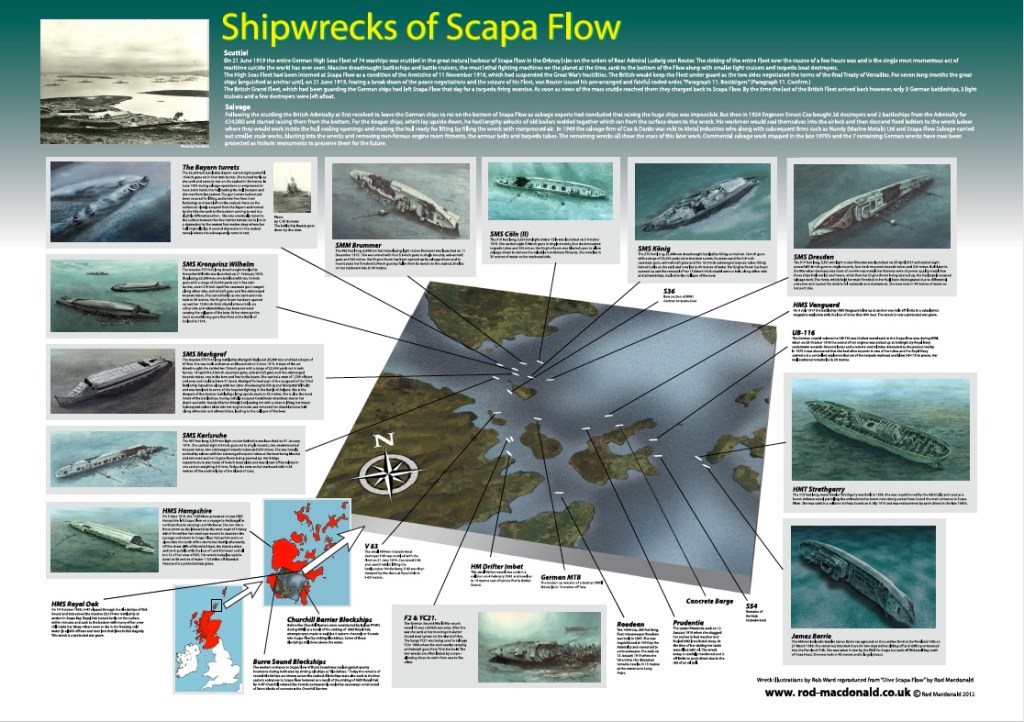
Here’s a short video of a dive on the massive 575 foot long dreadnought SMS Konig, lying on the bottom of Scapa Flow, Orkney in 42msw.
SMS Konig, Scapa Flow. The 74 warships of the interned Imperial German Navy, WWI High Seas Fleet, scuttled at Scapa Flow on 21 June 1919 to avoid being seized by the British Royal Navy. The Konig now rests upside down on the bottom – along with her sister Konig-class dreadnoughts Kronprinz Wilhelm and Markgraf
Yesterday I finally got to dive a special wreck that I have been keen to dive since its discovery in 2008, the German coastal submarine U 12. She was patrolling the east coast of Scotland in March 1915 when after sinking a 1,000-ton British steamship carrying a cargo of coal she was hunted down by three British destroyers. The following day, Aerial, Acheron and Attack sighted her on the surface and attacked. As she made to dive she was rammed near the bow. She then resurfaced and was engaged by British guns.
She sank with the loss of 20 crew and her wreck now rests upright in 50 metres in the Firth of Forth, North Sea.
Here’s the video of the dive;
Posted on
23 April 2019. HMS Hampshire 100 year anniversary survey
The Explorers Club report for the expedition I led in 2016 to survey this famous WWI armoured cruiser off NW Orkney is nearing completion and should be made public in next few months.
Just back from a couple of weeks diving the famous Japanese WWII wrecks at Truk Lagoon in the Pacific, the world’s greatest collection of Japanese wartime shipwrecks. It has been quite a long time since a new WWII wreck was located in the lagoon, but I was priviledged to be taken out by Truk Stop Dive Centre to a new wreck only found at the tail end of 2018 and only dived once before, when it was first located. The wreck turned out to be an intact 300-tonne Imperial Japanese Navy salvage and repair tug. Four were known to have been present at Truk at the end of the war, 2 have been located previously, Futagami and Ojima. There is no wartime damage to the new wreck – and I suspect it was scuttled by the Americans at war’s end. Although its identity has not yet been established a plate in the engine room suggest the tug was built at the Kawasaki dockyard, Kobe.
The 1,931grt standard coastal freighter Gosei Maru was built in 1937 and requisitioned by the Imperial Japanese Navy in 1941. She was anchored off Uman Island in Truk Lagoon on 17 February 1944 as aircraft from the surprise U.S. Task Force 58 Operation Hailstone swept across the lagoon destroying Japanese fighter cover. She took an aerial torpedo hit from a USS Monterey torpedo bomber and began to roll over onto her port side. Being ‘light’ she sank quickly with no time for her lifeboats to be launched. She now rests on a steep slope with her stern in about 10 metres and her bow deeper in about 35 metres.
27 December. Unkai Maru No 6 – Truk Lagoon. New dive video tour released
The Unkai Maru No 6 is one of the oldest wrecks in Truk Lagoon. She was built in 1905 in Newcastle, England as the SS Venus and had a long sea life before she was bought by Japanese interests and subsequently requisitioned by the Imperial Japanese Navy. She was dive bombed, set on fire and sunk by Task Froce 58 aircraft during OIperation Hailstone on 17/18 February 1944.See the video here;https://www.youtube.com/watch?v=R4-kz8adalw&t=74s
19 December 2018. New Truk Lagoon video tour released – Momokawa Maru
The Japanese auxiliary transport vessel Momokawa Maru was sunk by a 1,000-lb bomb from an American Curtiss SB2 dive bomber on 18 February 1944 during the 2-day fast carrier raid, Operation Hailstone. She was set on fire, settled by the stern and rolled to port. Here’s the link to my YouTube channel for it – subscribe if you want to be notified of further wreck tours: https://www.youtube.com/watch?v=osfjs5g233Y&t=264s